Introduction: Why Traditional Workplace Safety Needs to Evolve
Every manufacturing facility operates in an environment where people, machines, materials, and vehicles interact continuously.
Forklifts transport heavy loads, employees work around moving machinery, maintenance teams perform operations at height, and workers enter areas where specific safety precautions are essential.
Even with established safety protocols, trained personnel, and CCTV systems, maintaining consistent safety oversight across a large industrial facility remains challenging.
Consider a common situation.
A forklift is moving through a busy production area while a worker walks toward the same operating zone. Both may be following their usual routines, but a moment of distraction or reduced visibility could create a serious hazard.
Traditional CCTV may record the entire incident. However, unless someone is actively watching the relevant camera feed, the risk might not be identified until after an accident or near miss occurs.
This highlights a fundamental challenge: Recording workplace activity is not the same as actively monitoring workplace risk.
Artificial intelligence is helping bridge this gap.
By combining computer vision with industrial safety rules, AI-powered monitoring systems can identify certain unsafe conditions, recognize predefined hazardous interactions, and provide timely alerts to safety teams.
The objective is not to replace safety officers or established safety procedures. It is to provide an additional layer of monitoring that supports faster, more informed safety decisions.
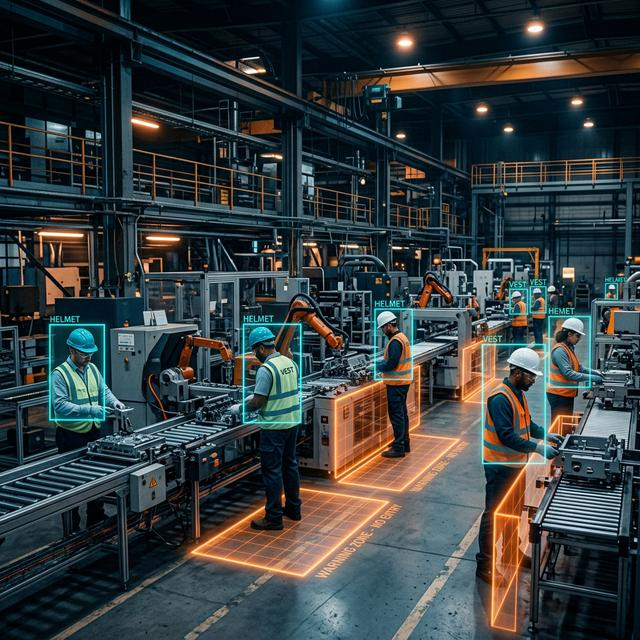
1. The Challenges of Traditional Safety Monitoring
Manufacturing organizations invest significantly in workplace safety programs, but several operational challenges remain.
Limited real-time visibility
Large manufacturing facilities may have multiple production lines, warehouses, loading areas, processing units, and restricted zones.
Monitoring every location simultaneously through manual observation is difficult, especially during continuous operations.
Reactive incident investigation
CCTV systems are often used to review events after an incident has occurred.
Although recordings provide valuable evidence, they may not offer an immediate warning when a hazardous condition first develops.
Inconsistent PPE monitoring
Safety equipment requirements vary depending on the work environment.
A worker may require a helmet and safety shoes in one area, while another task requires gloves, protective eyewear, or specialized equipment.
Manually verifying compliance across numerous locations is resource-intensive.
Risks involving moving equipment
Forklifts, palletizers, industrial vehicles, and moving machinery create environments where maintaining a safe separation between people and equipment is critical.
Busy production schedules, changing work patterns, and blind spots can increase the difficulty of identifying potentially unsafe interactions.
Limited visibility into recurring hazards
Individual safety observations may be documented through inspections, incident reports, and audits.
However, without consolidated monitoring records, recurring unsafe conditions may remain difficult to recognize and prioritize.
The opportunity lies in shifting from periodic observation toward continuous, risk-focused monitoring.
2. What Is AI-Powered Workplace Safety Monitoring?
AI-powered workplace safety monitoring uses artificial intelligence and computer vision to interpret visual information from cameras and identify predefined safety-related events.
Unlike conventional CCTV, which primarily captures video footage for viewing and recording, AI-powered monitoring systems can automatically examine camera feeds for selected risk conditions.
For example, an AI model may be configured to recognize:
- Workers entering designated hazardous areas.
- Missing helmets, safety vests, or other visually identifiable PPE.
- Pedestrians approaching forklift operating zones.
- Potentially unsafe conditions during work-at-height activities.
- Unauthorized entry into restricted operational areas.
When the system identifies an event matching a configured safety rule, it can generate an alert or create an incident record for further review.
This allows EHS teams to focus attention on specific events rather than continuously observing multiple video feeds.
The goal is to turn existing camera infrastructure into an additional source of actionable safety information.
3. How AI Works with Existing CCTV Infrastructure
One of the practical advantages of camera-based safety monitoring is the potential to integrate AI with existing CCTV infrastructure.
Rather than replacing every camera, compatible video streams can be connected to an AI processing system.
Step 1: Connect CCTV camera feeds
Existing cameras covering production areas, warehouses, access points, and other operational zones provide video feeds to the AI platform.
Camera compatibility, placement, lighting, and image quality are assessed before deployment.
Step 2: Configure workplace safety rules
Every industrial facility has different safety requirements.
Monitoring rules can be defined based on the area's hazards, operational conditions, and safety policies.
For example:
- A forklift zone requires pedestrian separation monitoring.
- A chemical handling area requires designated protective equipment.
- An elevated work area requires specific fall-protection controls.
- A restricted production area permits entry only under approved conditions.
Step 3: Detect predefined unsafe conditions
Computer vision models process video frames to identify visible objects, people, equipment, and relevant interactions.
When a configured rule is triggered, the system flags the event for further action.
Step 4: Generate alerts
Depending on the integration and site configuration, notifications can be delivered through monitoring dashboards, mobile devices, connected speakers, or smart warning lights.
Different hazards can be assigned different alert priorities and response procedures.
Step 5: Review and improve
Detected events can be reviewed by EHS teams to understand recurring risk patterns, investigate alerts, and identify opportunities for preventive improvement.
Over time, these observations can support more targeted safety inspections, training, and operational improvements.
4. Key Applications of AI in Workplace Safety
AI-powered monitoring can support several industrial safety use cases.
4.1 PPE Compliance Monitoring
Personal protective equipment plays an important role in reducing exposure to workplace hazards.
However, requirements can differ between departments, workstations, and specific industrial activities.
AI-powered camera monitoring can help identify visible PPE non-compliance, including missing:
- Safety helmets
- High-visibility vests
- Protective gloves
- Safety eyewear
- Safety footwear, where camera positioning permits
Example:
A worker approaches a chemical handling station without the required protective gloves.
A suitably configured camera system detects the visible PPE violation and notifies the responsible team before the task proceeds.
This provides an additional opportunity for intervention and reinforces consistent safety practices.
PPE detection should complement, not replace, proper hazard assessments, engineering controls, and worker training.
4.2 Forklift and Line-of-Fire Safety
Forklift operations are common in manufacturing facilities, warehouses, and logistics centers.
When pedestrians and moving equipment share operating spaces, hazardous interactions can occur.
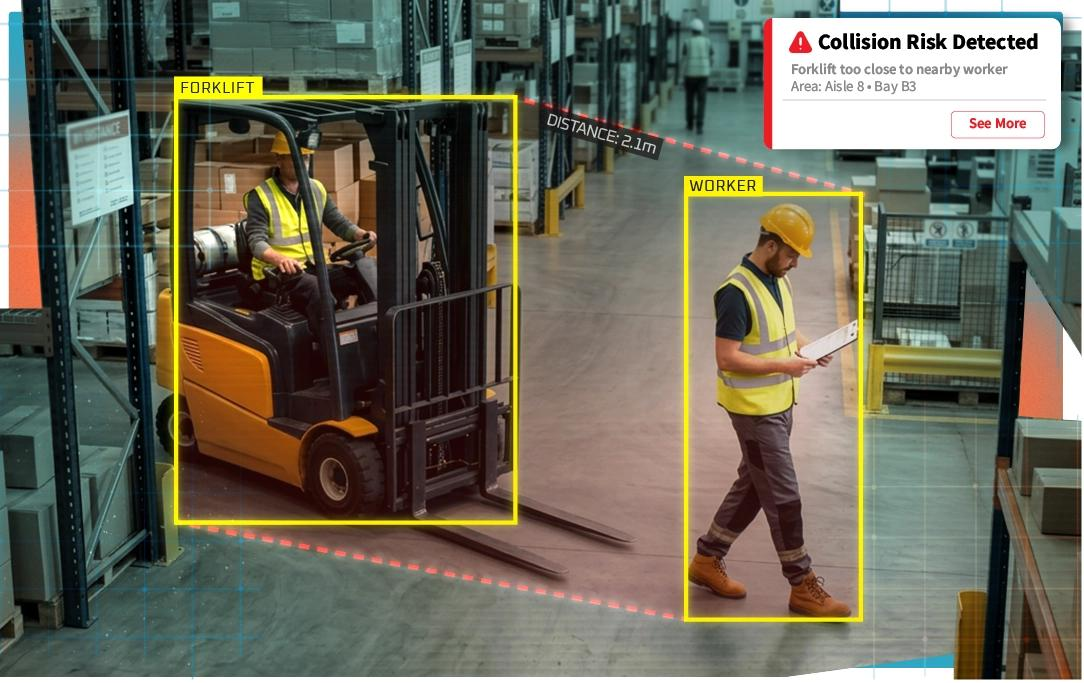
AI-powered monitoring can help identify selected situations such as:
- A pedestrian entering a forklift operating zone.
- Unsafe proximity between a worker and a moving forklift.
- Potential forklift-to-forklift proximity risks.
- People entering designated vehicle movement paths.
Example:
Two forklifts approach an intersection inside a warehouse while a worker crosses a nearby operational zone.
An AI monitoring system identifies the configured proximity condition and generates an alert.
Such alerts can help the safety team recognize potential hazards and respond according to site procedures.
The monitoring system works alongside essential controls such as separated walkways, physical barriers, traffic management, and operator training.
4.3 Work-at-Height Safety Monitoring
Maintenance, construction, equipment inspection, and other industrial operations frequently involve working at elevated locations.
Falls from height can lead to severe injuries, making appropriate fall-prevention and fall-protection measures essential.
With suitable camera visibility and use-case configuration, AI can assist in identifying visible indicators such as:
- Presence of a safety harness.
- Visibility of a lanyard.
- Apparent connection to a designated anchorage point.
- Entry into designated work-at-height zones.
Example:
A maintenance worker begins an elevated task while the lanyard does not appear to be connected to the designated anchor.
The system flags the visible condition for prompt review.
Importantly, camera-based detection cannot establish that a harness is correctly fitted, an anchor is structurally adequate, or the complete fall-protection system is safe.
Qualified personnel must continue to verify these conditions.
4.4 Restricted Zone Monitoring
Industrial facilities contain areas where unauthorized or uncontrolled entry can create serious hazards.
Examples include:
- Palletizer operating zones.
- Automated machinery areas.
- High-risk processing sections.
- Areas with moving industrial vehicles.
- Designated hazardous material handling locations.
AI-powered monitoring can recognize when a person enters a visually defined restricted zone.
Example:
An employee walks into an active palletizer operating area.
The camera-based monitoring system detects entry across a configured virtual boundary and triggers an alert.
This helps responsible personnel recognize the event quickly and initiate an appropriate response.
AI-based detection does not replace required machine guarding, safety interlocks, or physical access restrictions.
4.5 Worker Behaviour and Unsafe Activity Detection
Certain unsafe workplace behaviours can create hazardous situations even when the surrounding equipment is functioning correctly.
Site-specific AI monitoring may assist in detecting selected visual conditions such as:
- Unapproved entry into operational areas.
- Workers approaching active machinery.
- People occupying designated hazardous pathways.
- Certain unsafe movement patterns or activity conditions.
By identifying recurring events, organizations may gain better visibility into situations that need additional training, procedural changes, or stronger preventive controls.
Monitoring criteria should remain focused on legitimate safety requirements, with suitable privacy safeguards and human review.
4.6 Confined Space Safety Monitoring
Confined-space operations require careful planning, authorization, and monitoring because conditions can become dangerous rapidly.
AI-assisted visual monitoring may be configured to check for certain observable indicators, including:
- Presence of designated protective equipment.
- Visibility of required safety gear.
- Entry into a defined confined-space access area.
- Presence of specified external safety equipment.
However, cameras cannot determine oxygen levels, toxic gas concentrations, atmospheric safety, or the adequacy of a rescue plan.
AI monitoring must therefore operate as a supporting tool alongside permit-to-work procedures, gas testing, trained attendants, and other required confined-space controls.
4.7 Hygiene and Quality Compliance
In industries such as food processing, pharmaceuticals, and consumer goods, hygiene procedures help protect both workers and product quality.
AI monitoring can assist with selected visible compliance checks, including:
- Hairnet presence.
- Face mask presence.
- Required protective clothing.
- Ear protection visibility.
- Certain observable handwashing process steps.
For example, a worker entering a designated food-processing zone without a required hairnet may trigger an alert.
Camera-based checks cannot independently verify complete hygiene compliance, sanitation effectiveness, or microbiological safety.
4.8 Lockout/Tagout Safety Monitoring
Lockout/Tagout (LOTO) procedures are essential for controlling hazardous energy during equipment maintenance and servicing.
AI can potentially support monitoring of selected visible activities, including entry into maintenance zones or the presence of designated visual indicators.
However, a camera cannot verify zero-energy states, complete isolation, or all hazardous energy sources.
Therefore, AI-based monitoring should only supplement formally established energy-isolation procedures and verification by authorized personnel.
5. From Detection to Action: The Importance of Real-Time Alerts
Identifying a potential hazard is only the first stage of effective safety monitoring.
The next challenge is ensuring that the right people receive relevant information and can respond quickly.
Modern industrial environments often require more than a notification appearing on a central computer screen.
A practical AI monitoring strategy may use multiple alert channels.
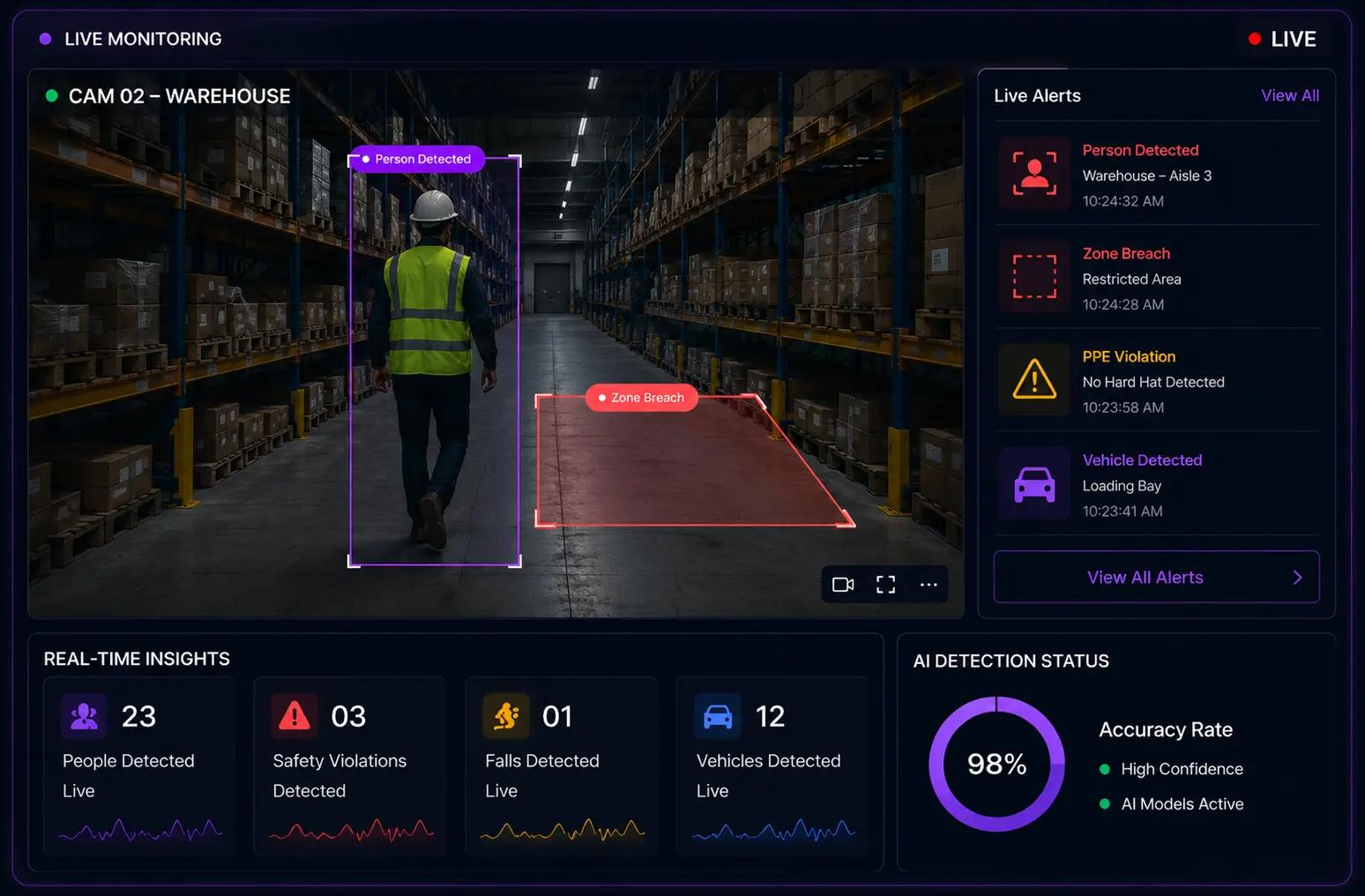
Dashboard alerts: EHS personnel can review detected events, their location, relevant camera footage, and associated monitoring rules.
Mobile notifications: Responsible supervisors can receive notifications when attention is required in their assigned operational areas.
Speaker announcements: Connected audio systems can provide local warnings where suitable for the facility.
Smart warning lights: Visual indicators can draw attention to selected hazards in noisy or high-activity environments.
These alert channels can be assigned according to the severity, location, and nature of the detected event.
For example, a forklift proximity event may require a local warning, while a recurring PPE non-compliance event may require supervisor review.
Effective alert design must also consider false alarms, alert fatigue, communication delays, and escalation responsibilities.
The real value of monitoring emerges when detected information leads to timely, appropriate action.
6. Key Benefits of AI-Powered Workplace Safety Monitoring
When implemented and validated appropriately, AI-powered monitoring can deliver several operational advantages.
Continuous monitoring of selected risk areas
AI systems can process configured camera feeds around the clock, helping safety teams maintain visibility across operational periods.
Earlier recognition of hazardous conditions
Selected unsafe conditions can be flagged as they occur, creating opportunities for intervention before a situation escalates.
Improved safety team efficiency
EHS professionals can spend less time manually reviewing routine camera footage and more time investigating meaningful safety events, conducting inspections, and implementing improvements.
Consistent application of configured monitoring rules
Once validated, predefined detection rules can be applied repeatedly across suitable camera views.
This supports consistent monitoring, although actual detection performance will depend on environmental and technical conditions.
Better understanding of recurring risks
Aggregated event records can help identify frequently observed hazards, affected locations, and changes in safety conditions over time.
Support for a proactive safety culture
Timely observations, constructive feedback, and data-informed reviews can help organizations reinforce preventive workplace safety practices.
These are potential benefits, not guaranteed outcomes. Effectiveness should be assessed through site-specific testing and measurable safety indicators.
7. What to Consider Before Implementing AI Safety Monitoring
Successful deployment requires more than connecting cameras to an AI model.
Organizations should consider the following:
Camera suitability: Are the relevant areas visible, and do existing cameras provide sufficient image quality?
Hazard prioritization: Which workplace risks should be monitored first?
Detection performance: How reliably does the system identify relevant events under actual site conditions?
Alert workflows: Who receives notifications, and what action must follow?
Worker privacy: How are video data, retention, access rights, and employee communications managed?
Integration: Can the monitoring system connect with existing EHS workflows and operational infrastructure?
Human oversight: Who reviews detections, handles incorrect alerts, and validates safety decisions?
A phased implementation is often practical.
Organizations can begin with a limited number of clearly defined, high-priority use cases, evaluate performance, and expand coverage as the system demonstrates reliability.
Importantly, AI monitoring should remain part of a wider safety management approach that includes hazard elimination, engineering controls, safe operating procedures, worker training, and regular inspections.
8. How ProvenienceX AI Supports Smarter Workplace Safety
At ProvenienceX AI, we believe workplace safety should be proactive, connected, and supported by actionable information.
Our AI-powered Workplace Safety & EHS solution is designed to help industrial organizations identify selected workplace hazards using computer vision and compatible existing CCTV infrastructure.
The platform focuses on practical monitoring applications across manufacturing and industrial environments, including:
- PPE compliance monitoring.
- Forklift and line-of-fire risk detection.
- Work-at-height monitoring.
- Restricted zone monitoring.
- Worker behaviour monitoring.
- Confined-space visual safety checks.
- Hygiene and quality compliance monitoring.
- Selected LOTO-related visual monitoring.
By combining AI-based event detection with configurable alert workflows, ProvenienceX AI aims to help EHS teams gain better visibility into workplace risks and respond to detected conditions more effectively.
The platform can also support monitoring workflows across compatible dashboards and configured notification channels.
Deployment capabilities, detection accuracy, and integrations are assessed according to each facility's operational conditions and requirements.
Our objective is simple:
Help organizations see risks earlier, act faster, and build safer industrial environments.
Conclusion: The Future of Workplace Safety Is Proactive
The future of industrial safety is not simply about installing more cameras or collecting more footage.
It is about making existing safety infrastructure more useful.
AI-powered monitoring offers manufacturing organizations an opportunity to move beyond passive observation toward continuous, targeted detection of selected workplace risks.
From PPE monitoring and forklift safety to restricted-zone detection and real-time notifications, computer vision can provide safety teams with additional information when and where it matters.
However, technology alone cannot create a safe workplace.
Effective safety performance still depends on sound engineering, trained personnel, clearly defined procedures, worker involvement, and accountable decision-making.
When combined with these foundations, AI can become a valuable supporting tool for proactive industrial safety management.
Safer workplaces begin with better visibility — and meaningful action.
Ready to Make Your Workplace Safer with AI?
SEE RISK. ACT FASTER.
Discover how ProvenienceX AI can help your organization use compatible existing CCTV infrastructure to monitor selected workplace risks, identify unsafe conditions, and support faster safety responses.
ProvenienceX AI — Empowering safer, smarter and more connected industrial operations.